The Offline Hobby Club · By Graham Ellery

Your next good hour
doesn't need
a screen.

Make something slightly wonky. Notice something wonderful. Rediscover the pleasure of doing a thing just because you like it.

No signup. No talent audition. Excellent attendance policy.

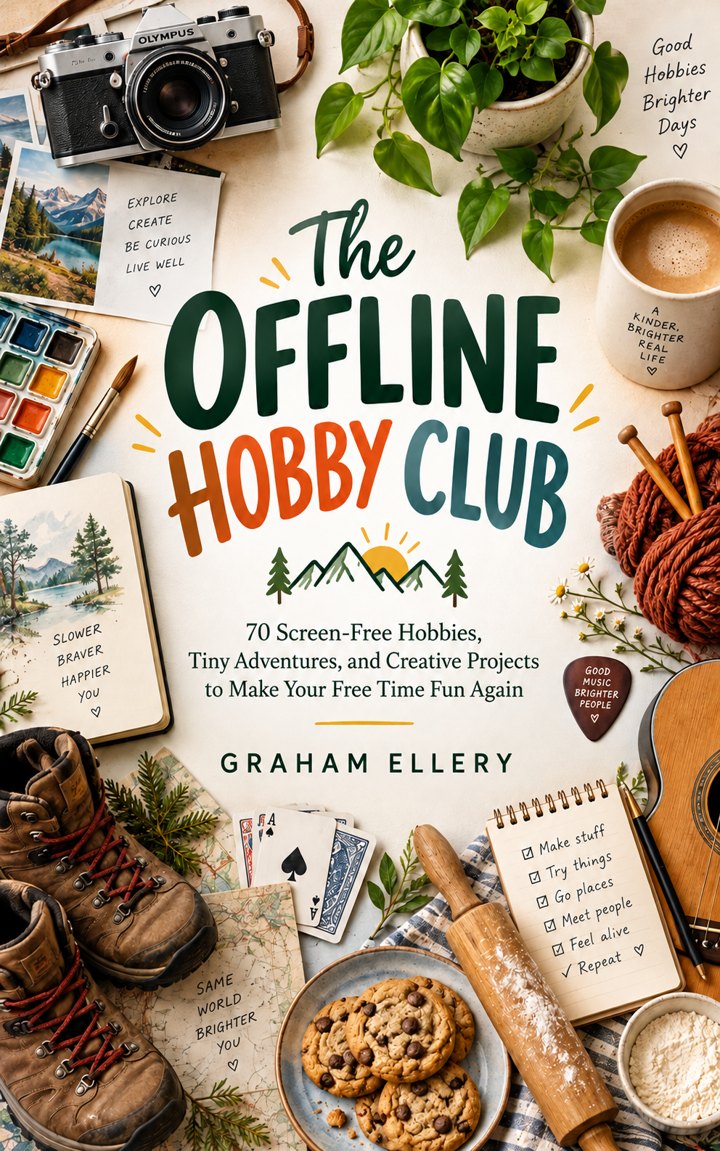
The Offline Hobby Club by Graham Ellery, with its cream cover and colorful title surrounded by hobby supplies
70 screen-free hobbies50 illustrationsSmall first projectsKindle · Paperback · Hardcover

Start where you are

“I should get a hobby”
is already taking up
too much of your time.

You don't need a new identity or a garage full of supplies. You need one small experiment that sounds more appealing than another hour of scrolling.


Blind-contour sketching

Paper, a pencil, and ten minutes. Draw a mug while watching the mug. A questionable likeness is part of the fun.

See all seven experiments ↓

The free 7-day offline hobby challenge

Seven small experiments.
Zero pressure to be good.

These original mini activities draw on hobbies explored in the book. Try one each day, repeat a favorite, or skip straight to the one that catches your eye. Use supplies you already have. Most take 10–20 minutes.

They are a starting taste, not complete hobby lessons. Adapt each activity to your comfort, access, and surroundings.

DAY 1 / 10 minutes

Draw the wonderfully wonky mug

Blind-contour sketching · Paper and a pencil

Put a mug on the table. Look at its outline while moving your pencil slowly across the paper. Keep your eyes on the mug, not the drawing, for one minute. Repeat twice. Circle one line you like. Accuracy has the evening off.

DAY 2 / 15 minutes

Send three sentences that matter

Real letters and postcards · Paper and a pen

Choose someone you appreciate. Write one specific memory, one thing you admire, and one question you would love to ask. Fold the note or make a postcard. Decide whether to hand it over or mail it later; postage is optional and not included.

DAY 3 / 15 minutes

Become a very local bird detective

Birdwatching · A window or safe outdoor seat

Sit quietly. Notice a bird's size, shape, movement, and sounds. Sketch a rough outline and write three observations. An unknown bird is still a bird worth noticing. Keep your distance and leave nests undisturbed.

DAY 4 / 20 minutes

Map a place by its small pleasures

Personal mapmaking · Paper and a pencil

Draw a rough map of your block, building, or favorite walk. Add three details a standard map would miss: the sunny seat, the creaky gate, the tree that changes first. Keep private addresses and personal routines off anything you share.

DAY 5 / 15 minutes

Give an ordinary object a sound track

Homemade Foley and sound stories · Paper, a cloth, and an empty box

Create a thirty-second journey using three gentle sounds: rustling paper, tapping a box, and brushing cloth. Perform the sounds in a sequence. Invite someone to guess the scene, or invent your own title. Keep volume comfortable. No recording or breakable objects needed.

DAY 6 / 20 minutes

Hold the smallest silent reading party

The silent reading party · A book you already own or borrowed

Read for fifteen uninterrupted minutes. If a friend joins you, agree that silence is part of the invitation. Spend the last five minutes sharing a passage in your own words, or write one thought for yourself. A party can wear slippers.

DAY 7 / 20 minutes

Rescue a recipe and its story

The family recipe rescue · Paper, a pen, and a remembered recipe

Write the name of a familiar dish and the person or place you associate with it. Record what you know, then mark unclear quantities or steps with question marks. Ask the cook later if possible. Today is about preserving the story, not cooking an unverified recipe.
The useful question at the end: “Would I like another twenty minutes of this?” A yes is enough. A no is useful information. Keep a favorite and invite one friend to try it.

A new invitation for curious friends

Your presence is requested.
Your talent is optional.

Host a No-Talent Night: three tiny hobby experiments in 35 minutes. Get the free host plan, printable invitation, and tasting card.

Plan your No-Talent Night →

The smallest club that could work

A table. A few friends.
One pleasantly
unimportant project.

A hobby club can be two people. Nobody has to teach a masterclass, buy a kit, or make anything worth framing. Libraries and community groups may also adapt this simple format for a free gathering.

Get the printable host plan

Your first 45 minutes

  1. 0–5: Welcome everyone. Choose one low-cost activity and agree that passing or observing is fine.
  2. 5–10: Try a small demonstration using supplies already on hand.
  3. 10–30: Make, notice, or experiment. No judging and no compulsory photos.
  4. 30–40: Share one discovery, one surprise, or one glorious mistake.
  5. 40–45: Clear the table. Decide whether to meet again.

Ask about access needs and permission before sharing anyone's work. Keep walkways clear. This starter session doesn't need food, heat, blades, or chemicals.

An invitation you can borrow

“Want to try something offline for 45 minutes? Bring a pencil and a scrap of paper. We'll draw something badly on purpose, have a laugh, and see what happens. No experience required.”

Free reuse permission: you may print and share the complete starter kit for personal use and free library or community gatherings, with Graham Ellery's credit and the book link intact. Please do not resell it or imply an endorsement.

Keep going with the book

From “that looks interesting”
to “I made that.”

The Offline Hobby Club: 70 Screen-Free Hobbies, Tiny Adventures, and Creative Projects to Make Your Free Time Fun Again by Graham Ellery helps curious adults choose, start, and continue hobbies that fit their actual lives.

  • Watercolor postcards, origami, simple bookbinding, and visible mending.
  • Fresh pasta, windowsill herbs, tea tasting, and the family recipe rescue.
  • Birdwatching, stargazing, architecture walks, and nature journaling.
  • Tabletop games, storytelling suppers, and small hobby exchanges.
  • Sauerkraut, sourdough, milk kefir, and kombucha, with precautions and tested-method sources.
  • Cyanotype prints, cardboard automata, miniature dioramas, scarf juggling, and other creative detours.

You'll find cost, space, energy, and company filters; fourteen starter paths; five-session practice ladders; second-project ideas; worksheets; and a year of offline weekend possibilities. The book contains 50 illustrations. Print editions have black-and-white interiors.

Available on Amazon

Find your next small adventure.

Kindle

$9.99

Browse the possibilities on your reader, then take the experiment offline.

View Kindle

Paperback

$24.99

484 pages · 6 × 9 inches
A companion for the kitchen table.

View paperback

Hardcover

$34.99

484 pages · 6 × 9 inches
For your shelf or a curious friend.

View hardcover

U.S. list prices. Amazon shows current prices, availability, taxes, and shipping.

A few things you don't need to worry about.

Do I need to be artistic?

No. The book starts with manageable experiments and encourages learning by trying. An enjoyable hobby does not have to produce something impressive.

Is every hobby free?

No. Some require supplies or equipment. The book helps you compare costs before choosing. The free challenge above is designed around ordinary items you may already have.

Is this a club membership?

No. It's a book, with optional free resources on this site. There is no membership fee, required subscription, or account to create.

Can a library or community group use the kit?

Yes. Share the complete kit free of charge for a free gathering, keeping the author credit and book link. You do not need to buy the book to use the kit.

More by Graham Ellery

Make room for more possibilities after 55.

Explore age-based benefits and everyday savings in The Free Side of 55+, or try the free savings starter.

Explore the savings guide →